
The rupee recovered 55 paise from its all-time low level to close at 90.38 against the US dollar after a volatile trade on Wednesday, amid suspected aggressive central bank intervention.


The fiscal tilt towards capex benefits companies in investment-related sectors like capital goods, defence equipment, engineering & construction and metal & mining. The planned cut in revenue expenditure will weigh on companies in consumption sectors like FMCG, consumer durables and retail.

Gold prices dropped by Rs 4,100 to Rs 121,800 per 10 grams in the national capital and slipped below $4,000 an ounce in the global markets on Tuesday as easing US-China trade tensions dampened safe-haven appeal. According to the All India Sarafa Association, the precious metal had closed at Rs 125,900 per 10 grams on Monday.

Foreign investors pulled out Rs 17,955 crore (Rs 2 billion) from Indian equities in the first two weeks of this month, taking the total outflow to Rs 1.6 lakh crore (Rs 18.4 billion) in 2025.' This sharp withdrawal follows a net outflow of Rs 3,765 crore in November, extending the pressure on domestic equity markets.

Stock markets will be driven by further developments on the US-China tariff war front along with quarterly earnings announcements from IT majors Wipro and Infosys in a holiday-shortened week, analysts said. Global market trends and trading activity of foreign investors would also dictate market movement this week, experts noted.

Among the Sensex constituents, Asian Paints, Tech Mahindra, HCL Technologies, Tata Steel, Maruti Suzuki India, Sun Pharmaceuticals, Tata Consultancy Services, ICICI Bank, Bajaj Finance, UltraTech Cement, Mahindra & Mahindra and Tata Motors Passenger Vehicles were the laggards. However, Eternal, Titan, Adani Ports, Bharat Electronics Ltd, State Bank of India, Bajaj Finserv, NTPC and Bharti Airtel were among the gainers.
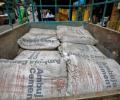
Investors have put money in Ambuja Cements shares as the cement major has moved to consolidate its operations. The Adani Group company has proposed to merge its subsidiaries ACC and Orient Cement into the parent entity.

Stock market participants would track global trends and foreign investors' trading activity in a holiday-shortened week ahead, amid lack of any major domestic trigger in sight, analysts said. Equity markets will remain closed on Wednesday for Christmas.

UBS has turned bullish on emerging markets (EM), including India, as it finds benign macro trends, positive momentum in earnings revisions, and resilient EM currencies helping these economies sustain higher valuations and attracting flows. Among regions, it has upgraded Mainland China to 'attractive' and China Tech to 'most attractive', while downgrading Philippines to 'neutral'.
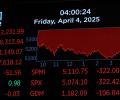
'If the US stagnates and falls into a recession, the dollar will weaken, oil prices will also dip. This augurs well for India.'

Indian information-technology (IT) service providers are likely to report another quarter (July-September) of low, single-digit growth owing to macro uncertainties, chiefly emanating from America, with no respite in sight even in the second half of the year.

'AUM reached an all-time high of Rs 79.9 trillion in October 2025, driven by strong retail participation and record SIP inflows of Rs 29,529 crore from over 94.5 million contributing accounts.'

'India is clearly moving toward more targeted treatment pathways in high-burden cancers.'

The rupee slumped 5 per cent in 2025 as persistent capital outflows from foreign investors, alongside heightened dollar demand from importers, making it one of the worst-performing Asian currencies.

Equity markets this week will turn their focus on the RBI's interest rate decision, Q1 earnings from several blue-chip firms and tariff-related news for further cues, analysts said. Moreover, trading activity of foreign investors and trends in global equity markets will also drive investors' sentiment.

India has gained the least since Russia invaded Ukraine in February 2022 and was penalised the most, while the US, China and the European Union emerged as the biggest beneficiaries from the war.

Analysts at Morgan Stanley have updated their outlook for the Indian markets, and they now expect the Sensex to hit the 107,000 mark by December 2026 in a bull-case scenario, translating into an upside of 26 per cent from current levels.
Global trends, trading activity of foreign investors and news flow on tariffs are expected to influence movement in the equity market in a holiday-shortened week ahead, analysts said. Equity markets would remain closed on Wednesday for 'Mahashivratri'.

Among the Sensex constituents, Bharat Electronics Ltd, Eternal, Trent, Tata Steel, Bajaj Finance, Adani Ports, Bajaj Finserv, State Bank of India, PowerGrid, Asian Paints, Tata Motors Passenger Vehicles, Titan, NTPC, Kotak Mahindra Bank, Larsen & Toubro and Bharti Airtel were among the laggards. Tech Mahindra, HCL Technologies, Reliance Industries and HDFC Bank were the only gainers.

Digital healthcare platform Practo is targeting annualised gross merchandise value (GMV) of $1 billion by June 2026, with its expanding US operations expected to contribute between $250 million and $300 million, according to people familiar with the company's plans.

Gold prices on Tuesday surged Rs 723 to touch an all-time high of Rs 110,312 per 10 grams in the domestic futures market, tracking strong global cues amid growing expectations of a US Federal Reserve interest rate cut next week. Traders said weak US labour market data has strengthened the case for monetary policy easing, putting pressure on the dollar and boosting demand for the safe-haven asset.

Companies are squeezing more profits from their operations relative to the capital they put to work, the highest now since 2011. Profit after tax relative to capital employed came in at 10.47 per cent in September, shows data from the Centre for Monitoring Indian Economy (CMIE), higher than the 8.41 per cent seen in September last year. This is the highest since March 2010.

'We expect modest returns in 2026 versus the steep gains seen over the past few years.'

The Reserve Bank of India's (RBI's) short dollar forward positions rose by $6 billion in September - the first increase in seven months - indicating the central bank's readiness to defend the rupee in the forward market amid pressure on the currency, latest data showed. The net short dollar position stood at $59.4 billion at the end of September, up from $53.4 billion in August.

Dalal Street investors were a poorer lot on Monday as their wealth eroded sharply by Rs 14 lakh crore following a sharp decline in benchmark indices amid a global market meltdown due to recession fears. The 30-share BSE Sensex tumbled 2,226.79 points or 2.95 per cent to settle at 73,137.90. Intra-day, the benchmark slumped 3,939.68 points or 5.22 per cent to 71,425.01.

The rupee appreciated 53 paise to close at 89.67 against the US dollar on Friday, supported by corporate dollar inflows and easing crude oil prices. Forex traders said a positive trend in domestic equities and Brent crude oil prices hovering near $59 per barrel supported the domestic unit at lower levels.

The continued MF buying has pushed the equity holding of MFs to over Rs 50 trillion for the first time.

Brent crude oil prices can touch $150 a barrel (bbl) - up a whopping 103 per cent from the current levels - in the worst-case scenario if the Israel-Iran geopolitical tensions escalate, suggest analysts.
Tata Steel was the biggest loser in the Sensex pack, sliding 8.59 per cent, followed by Tata Motors, Larsen & Toubro, Adani Ports, IndusInd Bank, Tech Mahindra, Reliance Industries, Sun Pharmaceutical, HCL Technologies, Tata Consultancy Services, Infosys, and NTPC, were the major laggards. On the other hand, Bajaj Finance, HDFC Bank, Nestle India, ICICI Bank, ITC, Asian Paints and Axis Bank were among the gainers.

Sanjay Malhotra has made structural changes to banking regulation to bring down costs and increase efficiency. Plus, he kicked off a benign interest regime. But there are challenges ahead.

Investors must account for currency depreciation in their financial plans and use instruments that can cushion the erosion in purchasing power.

'We expect inbound numbers in 2025 to come close to pre-pandemic levels -- if not fully match them -- by early 2026.'

The US Fed interest rate decision, global trends, tariff-related developments and trading activity of foreign investors will drive the equity market movement this week, analysts said. Among macroeconomic data announcement, WPI inflation for February is scheduled to be announced on Monday.

Investors would track a host of macroeconomic data announcements scheduled this week, including inflation numbers, and also monitor global market trends, and trading activity of foreign institutional investors, analysts said. The ongoing quarterly earnings announcements and the rupee-dollar trend would also influence the markets.

The rupee breached 90-levels against the greenback for the first time on Wednesday, falling 6 paise to 90.02 in early trade, as banks kept buying US dollars at higher levels and FII outflows continued.
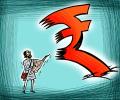
The rupee plunged 26 paise to an all-time low of 90.75 against the US dollar in intra-day trade on Monday, weighed down by uncertainty over an India-US trade deal and persistent foreign fund outflows.

Hit by a slowdown in information technology (IT) hiring, Info Edge (India)'s results for the July-September quarter (Q2) of 2025-26 (FY26) fell short of brokerage expectations. What helped the online recruitment major offset the weak IT hiring trend was broad-based growth across other sectors.

In an eventful week ahead, stock markets may face volatile trends before the RBI's interest rate decision and the US inflation data announcements, as investors continue to assess the broader implications of US tariffs on global economy and inflation, analysts said. Investors fear that a full-blown trade war will impact global trade and economic growth, according to market experts.

Cleaner balance sheets, regulatory support and strong growth prospects helped Indian private banks attract over $6 billion in foreign capital, with more deals expected in 2026.
 © 2026 Rediff.com - Advertise with us - Disclaimer - Privacy Policy - Sitemap - Feedback - About us - Terms of use - Grievances